

The president of the U.S. Conference of Catholic Bishops, Archbishop Paul S. Coakley, has denounced the Pentagon’s decision to publicly livestream the firing squad execution of Fort Hood gunman Nidal Hasan, warning that turning a military death sentence into a broadcast event promotes a “culture of death” and wounds the nation’s conscience.
Hasan, a former Army major and psychiatrist, was convicted by a military court in 2013 for killing 13 people and wounding more than 30 others in a 2009 mass shooting at Fort Hood, Texas, and was sentenced to death. Defense Secretary Pete Hegseth has said on multiple media platforms that the execution, scheduled for December 3, will be carried out by firing squad and made “public,” telling one interviewer, “We’ll make sure that people are able to watch it, that it’s public.” A Pentagon official has since confirmed to outlets including NPR, the Associated Press and Agence France-Presse that the killing will be livestreamed, marking the first execution carried out by the U.S. military in more than six decades and the first by firing squad since World War II.
In a statement released Friday and reported by Vatican News, the Washington Post and regional outlets, Coakley said he learned of the Defense Department’s decision “with shock and great sorrow” and framed his objection in explicitly moral terms. “Our God is the God of life,” he said, insisting that while Hasan’s crimes cannot be condoned, publicly broadcasting his death is “a barbaric promotion of a culture of death and must be reconsidered.” The archbishop warned that “the public execution even of one who has done grave harm will only further undermine the moral fabric of our nation and be a blight on the conscience of its people,” and he cited the New Testament admonition, “Do not repay anyone evil for evil” from Romans 12:17 as a guiding principle. Coakley also invoked the intercession of Our Lady of Good Counsel, praying that the United States would “always choose life even in the most trying times and circumstances.”
Coakley’s remarks carry institutional weight because he leads both the Archdiocese of Oklahoma City and the national bishops’ conference, which has long urged an end to capital punishment. The Denver Gazette and other regional outlets noted that his language echoed prior U.S. bishops’ teaching that opposition to the death penalty is part of a consistent defense of human dignity, and pointed out that the Catholic Church formally revised the Catechism in 2018 to state that the death penalty is “inadmissible” because it attacks the inviolability of the person. Catholic commentators responding to the statement have stressed that while Hasan’s victims and their families deserve justice and care, the church’s position rules out using execution—especially a televised one—as a means of retribution or deterrence.
Hegseth, a longtime supporter of capital punishment, has presented the livestream as a necessary message to potential attackers. In interviews cited by Reuters and the Los Angeles Times, he has described Hasan’s crimes as a “radical Islamist terror attack” on U.S. service members and called the firing squad a “no brainer” response. “People need to understand that there are serious consequences for these types of things,” he said, arguing that making the execution visible to the public underscores the gravity of Hasan’s actions and the resolve of the military justice system. AFP reported that in one Pentagon-distributed video clip, Hegseth said Hasan “is going to get a firing squad of soldiers, as it should be, and we’ll make sure that people are able to watch it, that it’s public.”
Legal and ethical questions have quickly surrounded the Pentagon’s plan. The Associated Press reported that experts in military and constitutional law see no straightforward path for courts to block the broadcast under current statutes, even as they acknowledge that a livestreamed execution would be unprecedented in modern U.S. practice. NPR and other outlets have noted that while executions have historically been public in some eras, the U.S. moved decisively away from such spectacles in the twentieth century, and contemporary protocols emphasize controlled, limited witness lists rather than open viewing. Critics of the Hasan livestream worry that televising his death could desensitize viewers, retraumatize survivors of the Fort Hood shooting, and risk turning state punishment into a kind of macabre entertainment.
Beyond Coakley’s intervention, faith-based advocacy groups that have campaigned against capital punishment have begun highlighting the Hasan case as emblematic of what they see as dangerous new territory. Reports from Catholic media and wire services say organizations that work to end the death penalty nationwide are preparing educational materials and public statements that challenge not only the method of execution but the decision to make it a spectacle. For these groups, the Hasan livestream underscores a larger concern: that the machinery of state violence, once hidden from view, is now being repackaged as a teachable moment, in ways that may conflict with religious traditions that emphasize repentance, mercy, and the intrinsic worth of every human life.
As the December date approaches, the Pentagon has yet to release technical details about how the livestream will be carried out or who will be able to access it, beyond assurances to major news outlets that it will be available to the general public. Coakley’s statement positions the U.S. bishops as prominent religious voices urging a reversal of that decision, and it signals that debates over the death penalty—and over how much of it Americans should see—will remain at the forefront of Catholic engagement with national policy.
Image Credits:
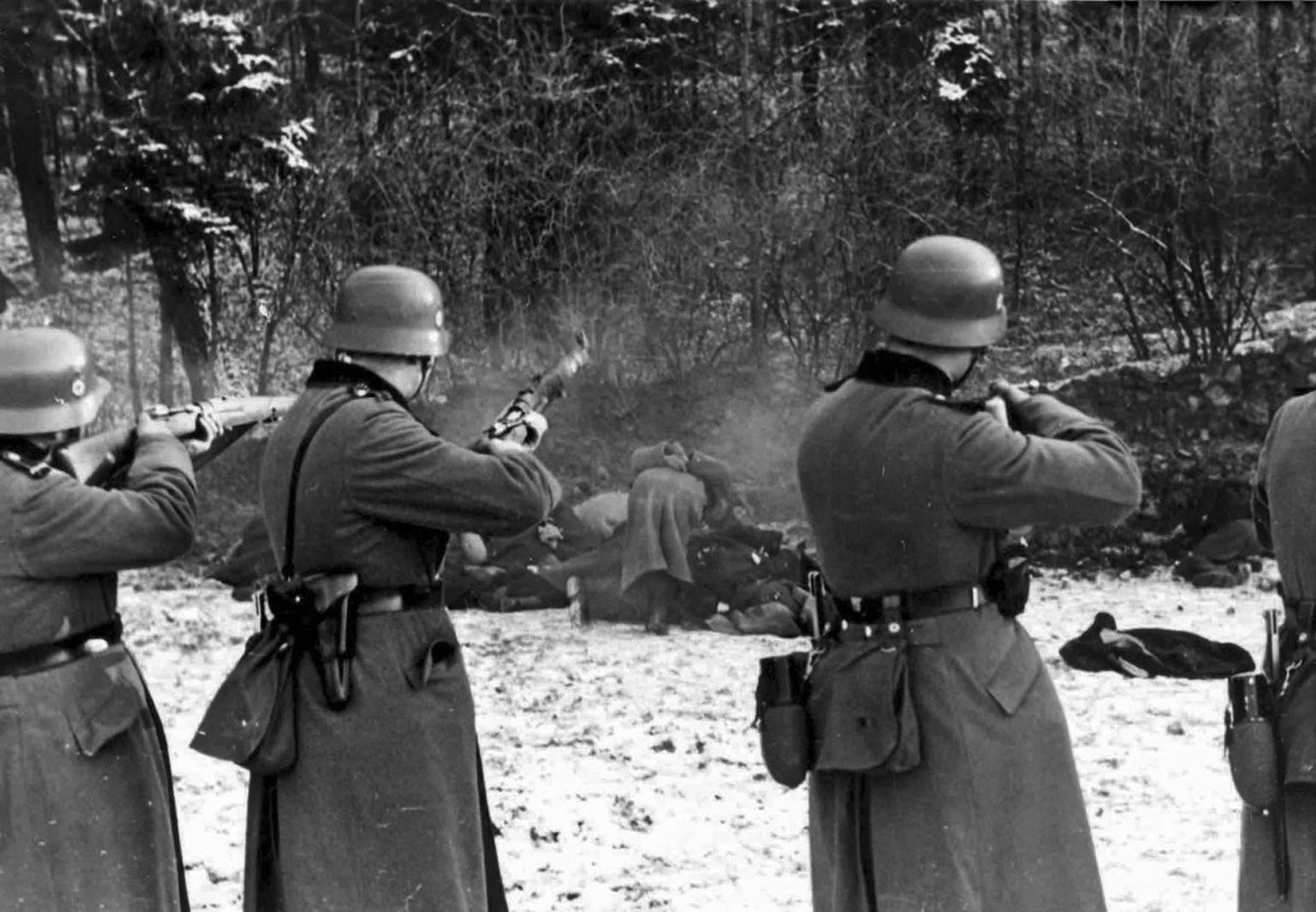
• The execution of 56 Polish citizens in Bochnia, near Kraków, during German occupation of Poland, December 18, 1939 in a reprisal for an attack on a German police office two days earlier by the underground organization "White Eagle". via Wikimedia Commons by album of a captured German officer. Other photo(s) from the album may have been copied by Stanislaw Broskewicz, a photo developer working for the Germans with usage type - Public Domain, This photograph is in the public domain because according to the Art. 3 of copyright law of March 29, 1926 of the Republic of Poland and Art. 2 of copyright law of July 10, 1952 of the People's Republic of Poland, all photographs by Polish photographers (or published for the first time in Poland or simultaneously in Poland and abroad) published without a clear copyright notice before the law was changed on May 23, 1994 are assumed to be in the public domain in Poland.
Featured Image Credit:
• The execution of 56 Polish citizens in Bochnia, near Kraków, during German occupation of Poland, December 18, 1939 in a reprisal for an attack on a German police office two days earlier by the underground organization "White Eagle". via Wikimedia Commons by album of a captured German officer. Other photo(s) from the album may have been copied by Stanislaw Broskewicz, a photo developer working for the Germans with usage type - Public Domain, This photograph is in the public domain because according to the Art. 3 of copyright law of March 29, 1926 of the Republic of Poland and Art. 2 of copyright law of July 10, 1952 of the People's Republic of Poland, all photographs by Polish photographers (or published for the first time in Poland or simultaneously in Poland and abroad) published without a clear copyright notice before the law was changed on May 23, 1994 are assumed to be in the public domain in Poland.