

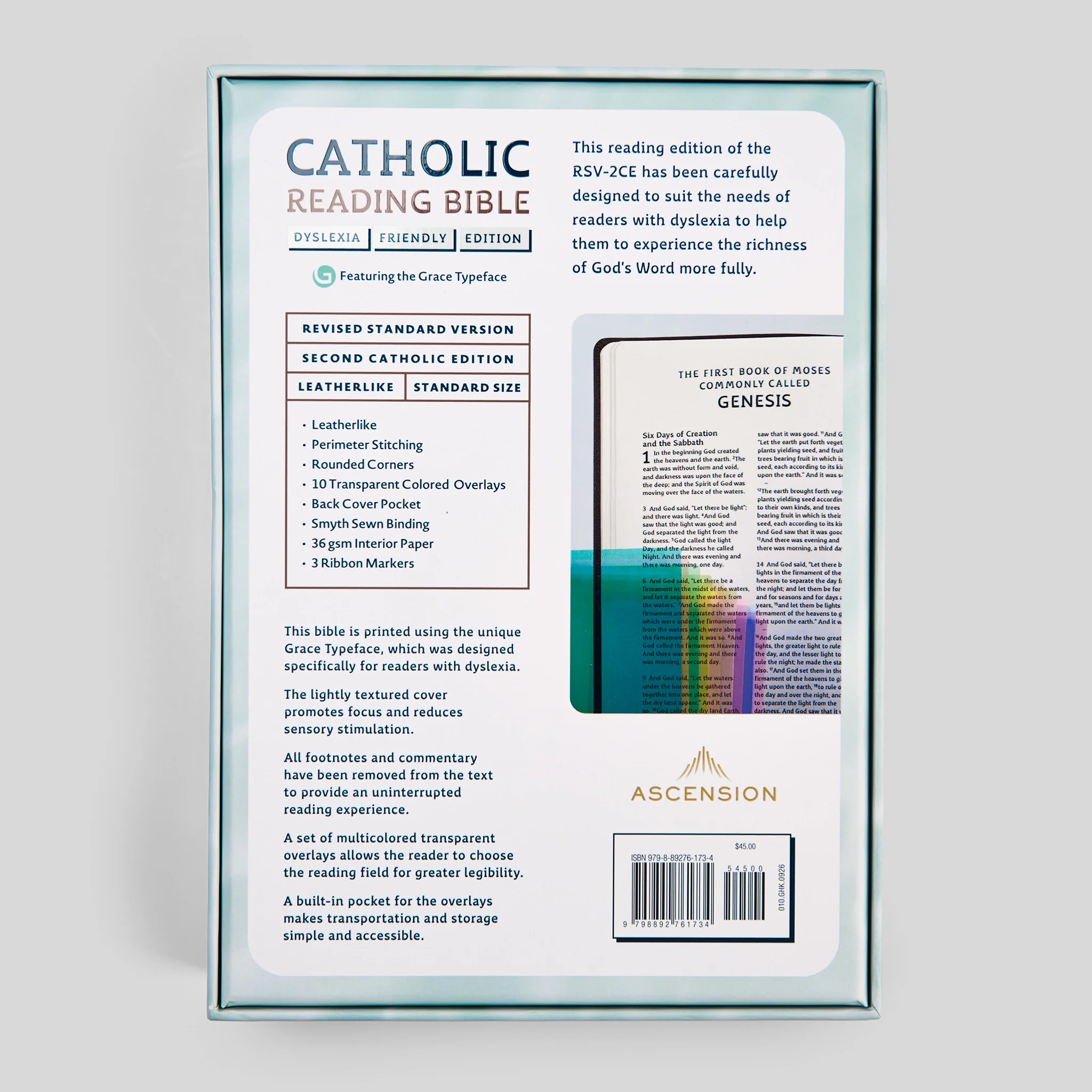
Ascension, a Catholic publisher known for popular Scripture resources, has released a dyslexia-friendly edition of its Catholic Reading Bible that uses the Grace typeface to support readers who experience visual stress and other reading challenges.
The Catholic Reading Bible: Dyslexia-Friendly Edition is being introduced in conjunction with International Dyslexia Day on October 8 and is described by Ascension as the first complete Catholic Bible set entirely in the Grace typeface and its associated design system. The volume contains the Revised Standard Version, Second Catholic Edition (RSV-2CE), the same translation used in Ascension’s Great Adventure Catholic Bible and its widely followed “Bible in a Year” podcast, positioning the new format as an accessibility-focused complement to resources already familiar to many Catholics.
Grace was developed by Danish Bible design firm 2K/DENMARK in collaboration with researchers at the University of Cambridge, with the goal of creating a font and page layout that reduce the visual distortions some readers experience when tracking lines of text. The typeface places extra weight toward the bottom of each letter to help “anchor” characters to the baseline, and differentiates commonly confused pairs such as b and d or p and q through distinctive shapes and spacing. Design guidelines for Grace editions also limit line length to roughly 35 characters, break up long paragraphs into smaller blocks, avoid bold and italics, and use an 11‑point size with generous line spacing so the page feels less crowded to the eye.
In keeping with other Grace-based Bibles, Ascension’s edition includes colored reading overlays that can be placed over the page to reduce glare and visual stress for some readers. Similar overlays in earlier Grace Bibles have been offered in multiple hues so that individuals can test which tones make text most comfortable to read, an approach described in technical materials for the CSB Grace Bible and on discussion forums where dyslexic readers share their experiences. Retail listings for the Catholic Reading Bible: Dyslexia-Friendly Edition describe a brown leatherlike cover, Smyth-sewn binding, three ribbon markers, and a built-in pocket at the back of the book to store nine colored overlays and one gray overlay.
The release comes amid a broader movement among Christian publishers to produce Scripture editions designed with dyslexic and neurodivergent readers in mind. Lifeway’s B&H Publishing Group has partnered with 2K/DENMARK and Cambridge University to create CSB Grace Bible for Kids and a CSB Grace Bible for adults, both laid out with the same font and spacing principles and marketed as dyslexia-friendly. In the Netherlands, the Dutch Bible Society (NBG) announced a Grace-based edition of the NBV21 translation earlier this year, calling it the “very first dyslexia-friendly Bible” in that language and highlighting the typeface’s extensive testing with readers.
Behind the Grace project is designer Klaus Erik Krogh, founder of 2K/DENMARK, who spent years focusing on how typography can serve readers of complex, densely formatted texts like Bibles. Publishers Weekly reported that Krogh devoted five years to developing Grace specifically to make reading easier for people with dyslexia, drawing on research into visual processing and iterative testing with focus groups before the typeface was released. Tributes following his death in October at age 74 have emphasized the pastoral impact of the project, recounting scenes at B&H events where children reacted with emotion when they realized they could follow the text in Grace-formatted Bibles more comfortably than in standard editions.
Early reactions from lay Catholics and readers with dyslexia suggest similar expectations for Ascension’s new volume, with online Catholic communities sharing news of the release and expressing interest in how the overlays and layout might translate into parish and home use. Ascension has framed the dyslexia-friendly Bible as part of its ongoing effort to remove practical barriers to scriptural engagement, pointing to the Catholic Church’s longstanding encouragement that Scripture be made easily accessible to all the faithful and situating the Grace edition within that pastoral priority. With the book now available through Ascension and Catholic retailers at a list price of $45, the coming months will reveal how widely parishes, schools, and families adopt this specialized format as a tool for helping more Catholics read the Bible with confidence.