

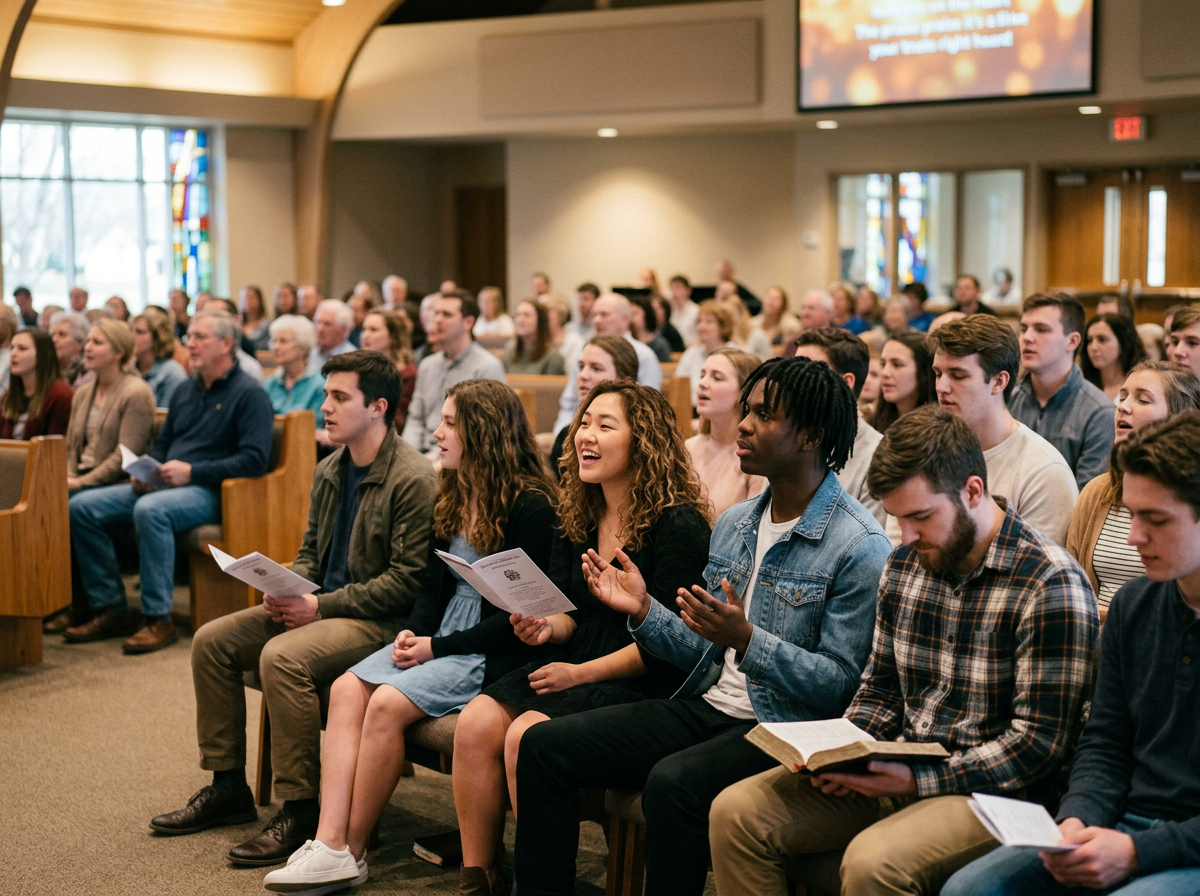
One in three U.S. young adults says they are attending church more often than they were a year ago, according to new survey data from Barna Group that highlights a quiet but notable shift in how Gen Z and Millennials are engaging with local congregations. Prayer emerges as the primary reason these young adults give for showing up, suggesting that spiritual practices rather than programs or social events are driving much of the increase.
The findings come from a study of 3,049 adults ages 18 to 35, conducted online in October 2025 as part of Barna’s State of the Church research initiative, which Barna undertook in partnership with the ministry tech platform Gloo. In the survey, 34 percent of respondents reported attending church more often than they did a year earlier, 45 percent said their attendance had stayed the same, and 21 percent said they attend less frequently. Nearly half of young adults—45 percent—selected prayer as a reason they go to church, ahead of worship, teaching or social connection, with Black and Hispanic respondents most likely to rank prayer first. Barna’s analysis notes that spiritual motivations such as prayer, worship and “experiencing joy in Jesus” are more commonly cited than the desire for better programming or more polished production.
Barna’s broader 2025 tracking data reveals that this uptick is not uniform across young adults, with young men and Black young adults especially likely to say their attendance has increased. In a separate report on attendance trends, Barna found that as of 2025, 43 percent of young men reported attending church weekly, compared with 36 percent of young women, the largest gender gap the firm has recorded in 25 years of measuring regular churchgoing. Gen Z and Millennial men now report higher levels of engagement than their female peers, reversing long-standing patterns in which women were more likely to be regular attenders. Barna researchers and commentators point to factors such as work and caregiving burdens, pay disparities and burnout to help explain why many young women report less capacity to be in church weekly, even when they retain strong faith commitments.
When Barna looks specifically at how often churchgoing young adults attend services, the trend lines point upward compared with the years immediately following the COVID-19 pandemic. The typical Gen Z churchgoer now attends about 1.9 weekends per month and Millennial churchgoers about 1.8 weekends, nearly one additional Sunday a month compared with 2020. Those figures mean younger churchgoers are in worship more frequently than older generations, even though they still attend less than half of all available weekends. Coverage in outlets such as Our Sunday Visitor and Christianity Today has underscored that this pattern represents a shift from earlier in the 2000s, when young adults were often the least frequent attenders among churchgoing Americans.
Within the new young adult study, Barna reports that worshiping Jesus alongside other people ranks just behind prayer as a primary reason for attending, with women somewhat more likely than men to emphasize communal worship. Social motivations follow these spiritual ones: roughly one in four young adults say they go to church seeking deeper relationships with other Christians, and a similar share say they attend to learn from people who have faced experiences similar to theirs. The young adults most likely to report increased attendance—particularly young men and Black and Hispanic respondents—are also those most likely to say prayer and shared worship are what draw them to services, reinforcing the idea that spiritual hunger and belonging are closely intertwined.
Despite the encouraging numbers among young churchgoers, both Barna and other researchers caution against calling the trend a revival or assuming that it reflects a broad surge in U.S. religious participation. A fact-check by Deutsche Welle notes that Barna’s data describes how often existing churchgoers attend, not how many young adults in the wider population are involved in congregational life, and points out that other federal survey data do not show a sharp rise in churchgoing among Gen Z overall. A separate analysis from the Pew Research Center, drawing on time-use surveys between 2021 and 2024, finds no significant increase in the share of young adults who say they attended religious services on a given Sunday, even as the long-term decline in U.S. Christianity appears to have slowed. Barna’s own commentary frames the recent numbers as evidence of spiritual curiosity and a desire for meaning and belonging rather than a sweeping spiritual movement, urging churches to see them as an invitation to deepen discipleship among those who are already coming.
Barna’s follow-up surveys with pastors suggest that many church leaders are seeing the same patterns on the ground, reporting greater openness to Jesus, increased Bible reading and more faith commitments among younger adults who participate in their congregations. At the same time, pastors say they are wrestling with how to support young adults who attend irregularly, or who remain spiritually curious but wary of institutional religion. The State of the Church project, which continues with new wave surveys into 2026, is designed to give churches detailed insight into these dynamics so they can respond with thoughtful hospitality, teaching and community life rather than chasing quick fixes or trend-driven programming. As ministries digest the latest data, one clear takeaway is that a sizable minority of young adults are choosing to show up more often—and they are doing so primarily to pray and to seek God together with others.