

Republican congressman Andy Ogles has lost his bid for renomination in Tennessee’s 5th Congressional District, a defeat for a Trump-backed incumbent whose brand of hard-line Christian-infused politics and harsh rhetoric toward Muslims had drawn growing scrutiny from both parties.
Major outlets projected Ogles’ loss on Aug. 6 after former state agriculture commissioner Charlie Hatcher, a dairy farmer and veterinarian, finished ahead of him in the Republican primary for the Nashville-area seat. With most precincts reporting, Hatcher led Ogles by several percentage points, turning what had been expected to be a safe path to renomination into one of this cycle’s more notable upsets for an incumbent House Republican.
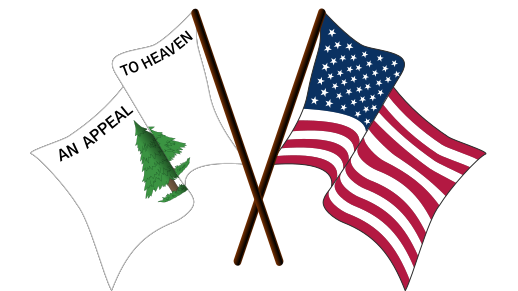
Ogles first won the seat in 2022 and quickly aligned himself with former President Donald Trump, embracing a hard-right posture on immigration and public expressions of Christian identity. Reporting from national outlets has described him as a hard-line conservative who faced backlash over anti-Muslim and anti-immigrant rhetoric, part of a broader pattern critics tie to Christian nationalist themes that frame the United States as inherently and exclusively Christian.
The defeat is notable because Trump had endorsed Ogles and even participated in late-campaign efforts on his behalf, yet Hatcher secured substantial backing from establishment Republicans and outside groups that poured millions into the race. Coverage of the contest has noted that super PAC spending against Ogles, combined with a significantly reshaped district following recent redistricting, helped blunt the impact of Trump’s support and underscored that overtly hard-line rhetoric does not guarantee victory even in a deep-red seat.
Debate over religious pluralism and the place of minority faiths in public life has also been prominent in Tennessee’s gubernatorial politics this year. Local television reporting documented how state Rep. Monty Fritts, running in the Republican primary for governor, said he would work to ban mosques and what he called “pagan religions,” including Islam, Buddhism and Hinduism, arguing that Islam is “not necessarily a religion” but a political movement he sees as incompatible with the U.S. and Tennessee constitutions. In the same interview, he contended that the First Amendment’s opening word “Congress” limits its application to the federal government rather than the states, a claim legal scholars and many Christians who champion religious liberty strongly dispute.
For Christian readers, these contests raise important theological questions. Scripture teaches that all people bear the image of God (Genesis 1:27) and that believers are called to love their neighbors, including those of other faiths, as themselves (Luke 10:25–37) and even to love their enemies (Matthew 5:43–48). Calls to exclude Muslims from American society or to shutter their houses of worship stand in tension with these commands and with the biblical pattern of seeking the good of the broader community—even in contexts where God’s people are a minority, as seen in Jeremiah 29:7.
The language of a “Christian nation” also requires careful discernment. While many Christians are grateful for the historic influence of Christian ideas on American life, the New Testament consistently emphasizes that the church’s primary citizenship is in heaven (Philippians 3:20) and warns against confusing the gospel with any particular nation or political program. When Christian identity is fused with partisan loyalty or used to justify denying basic civil rights to religious minorities, the witness of Christ’s church can be obscured and the command to “show proper respect to everyone” (1 Peter 2:17) undermined.
Ogles’ loss does not by itself settle the future of Christian nationalist rhetoric in Republican politics; his defeat came amid unique local conditions, including redrawn district lines and heavy outside spending, and many candidates who invoke Christian language continue to win elsewhere. Still, the Tennessee results suggest that voters are weighing not only policy positions but also tone and testimony—how candidates speak about neighbors of other faiths and how they frame America’s religious character—when they step into the voting booth.
For believers in Tennessee and beyond, this moment invites prayerful reflection on how to engage politics as disciples of Jesus: advocating for justice and moral clarity while honoring the God-given dignity of all people, including Muslims, Jews, and those of no faith. Passages such as 1 Timothy 2:1–2 call Christians to pray for leaders and those in authority, regardless of party, so that the church may lead “peaceful and quiet lives” marked by godliness and holiness. In a season of heated rhetoric, the way Christians speak about and vote for candidates like Andy Ogles and Monty Fritts will say as much about the gospel they believe as any campaign slogan ever could.