

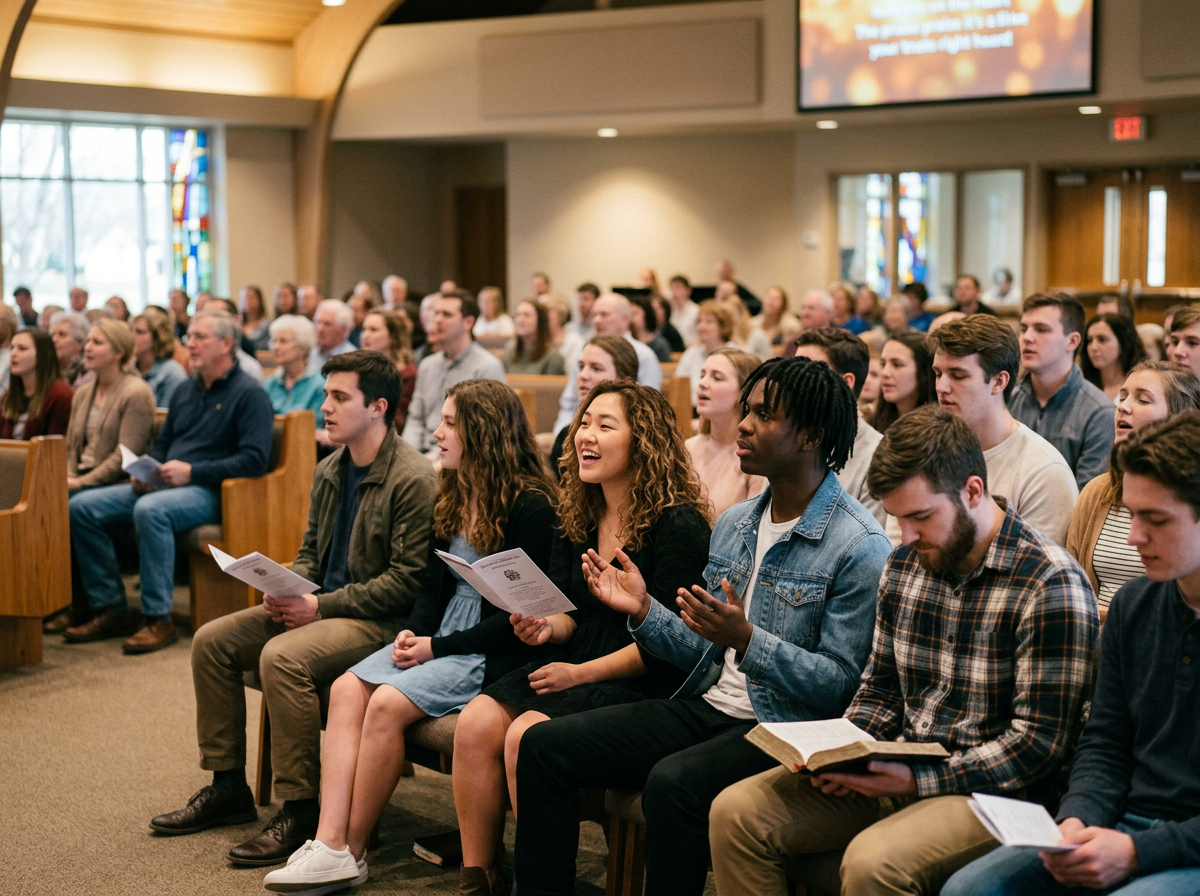
A new Barna survey finds that reconnecting with faith is the leading personal reason young adults attend church, while political engagement is more influential among young men than young women.
Forty-three percent of U.S. adults ages 18 to 35 surveyed by Barna said reconnecting with their faith was a reason they attend church. Learning more about themselves and experiencing better mental health tied for second at 30% each, followed by getting support for life challenges at 26%. Knowing their spiritual gifts and being part of a story larger than their own each registered at 25%, while 23% cited exercising their spiritual gifts. Political engagement was the least common reason overall, at 12%, according to Barna’s report.
The gender differences were most pronounced around politics and personal support. Thirteen percent of men ages 18 to 24 and 15% of men ages 25 to 35 said political engagement was a reason they attend church. Both figures were higher than the rates reported by women in the same age groups. Barna said the results suggest some young men may be seeking political information and engagement through congregational involvement.
Young women ages 18 to 24 were more likely than any other age-and-gender group to cite reconnecting with faith, improving their mental health and receiving support for personal challenges. The report also found that 30% of women ages 25 to 35 selected none of the personal reasons surveyed, the highest rate among the groups analyzed.
The findings are part of a three-part State of the Church series produced by Barna in partnership with Gloo. Earlier reports examined spiritual and social motivations for church attendance. In the spiritual research, prayer was the leading reason, cited by 45% of young adults, while the social report found that 24% attended in search of deeper relationships with other Christians.
“Young adults’ personal motivations for attending church are primarily for inward reasons—reconnecting and self-discovery,” Daniel Copeland, Barna’s vice president of research, said in the report. He added that church leaders should take those motivations seriously while helping young adults turn toward community and contribution.
Barna collected the survey data from Oct. 17-30, 2025, among 3,049 U.S. adults ages 18 to 35. The report gives a margin of error of plus or minus 1.3 percentage points at a 95% confidence level. It also found that new followers of Jesus were more than three times as likely as non-followers to attend church for support with life challenges—38% compared with 11%.