

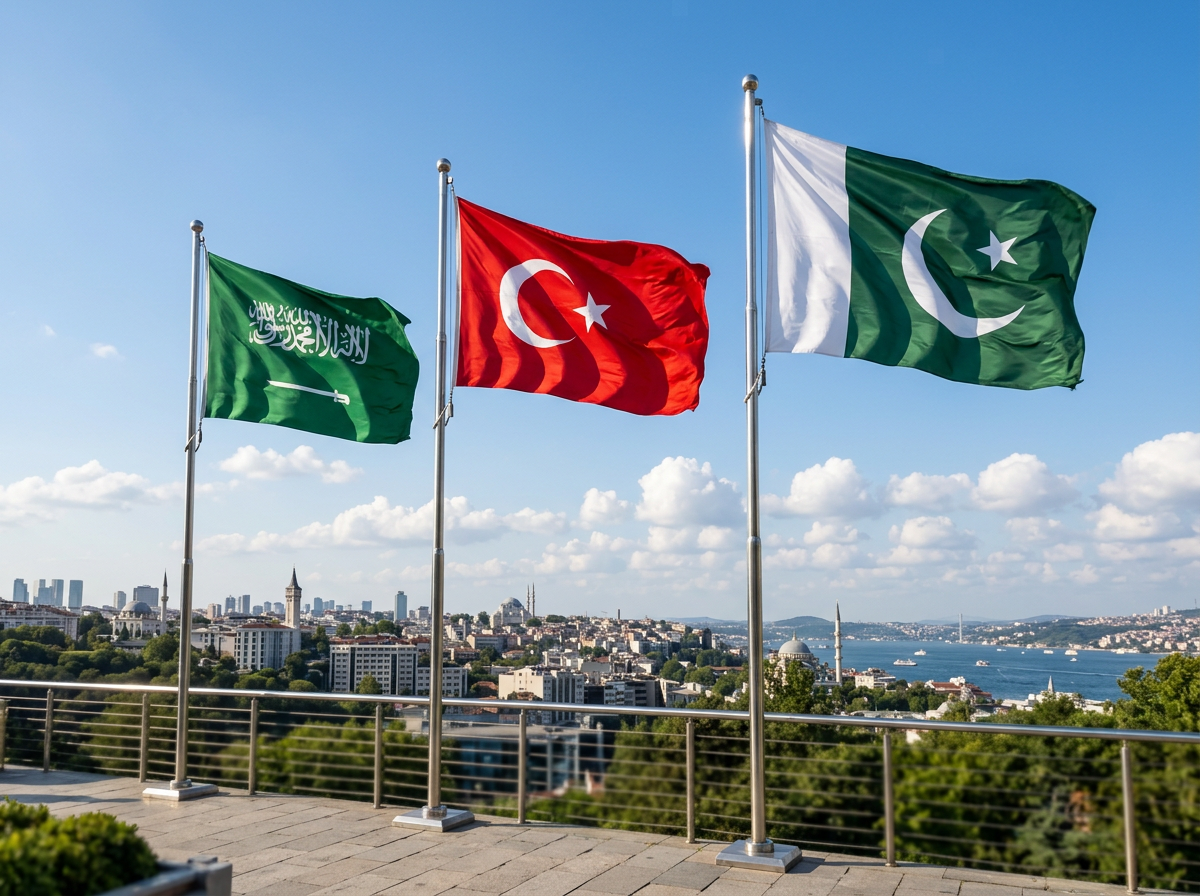
The new Mecca Joint Defence Agreement between Saudi Arabia, Turkey and Pakistan is designed to deter attacks and manage the risks of the war with Iran, but it also signals a reduced U.S. role in regional security that both constrains and complicates American policy. For Christians watching the region, the pact highlights shifting power dynamics that may lower immediate risks for some civilians while deepening a long-term reliance on military tools rather than diplomatic reconciliation.
On 7 August 2026, Saudi Crown Prince Mohammed bin Salman, Turkish President Recep Tayyip Erdoğan and Pakistani Prime Minister Shehbaz Sharif signed the Mecca Joint Defence Agreement in the city of Mecca, committing their countries to treat an armed attack on any one as an attack on all three. A joint statement from the three governments said the pact aims “to strengthen collective deterrence against any act of aggression” and to enhance defence cooperation in areas such as training, logistics and intelligence-sharing. While media reports have described it as a mutual defence alliance, the endorsed Arabic text published in Saudi Arabia’s official gazette leaves obligations relatively general and makes clear that the pact does not override existing treaty commitments, suggesting a flexible framework rather than a rigid military bloc.
The trilateral agreement builds on a Saudi‑Pakistan mutual defence pact signed in September 2025 and follows almost a year of negotiations in which officials from Ankara and Islamabad indicated that a draft three-way framework was already prepared. Analysts at institutions such as Chatham House and the Atlantic Council stress that the Mecca pact is not a NATO-style alliance with integrated command structures, but a political commitment to closer security coordination among three Sunni-majority powers. A Turkish official quoted in regional coverage described the arrangement as “purely defensive in nature,” while Saudi sources have emphasized that it is not intended to launch an arms race or damage relations with other Arab and Gulf partners.
The agreement comes more than five months into the United States–Israel war against Iran, a conflict that has seen Iranian missiles and drones target Gulf oil infrastructure and disrupt shipping through the Strait of Hormuz. Iranian-backed Houthi fighters in Yemen have renewed attacks on Gulf states, and Tehran has openly urged Middle Eastern governments to create a regional security bloc that excludes both the U.S. and Israel. Commentators have described a developing “Pax Israeliana” as American forces draw down and Israel acts as a de facto regional hegemon, intensifying Sunni–Shia rivalry and fueling the desire of Saudi Arabia, Turkey and Pakistan to coordinate their response to both Iran and Israel. From this angle, the Mecca pact can be read as both a hedge against further Iranian escalation and a signal to Washington that these states will not indefinitely rely on U.S. security guarantees.
In the short term, U.S. policymakers may welcome greater capacity among regional partners to deter Iran and protect energy infrastructure, potentially reducing pressure for direct American military intervention. At the same time, the emergence of a distinct Sunni defense compact complicates U.S. efforts to build an integrated security architecture that includes Israel and Gulf allies, and could introduce new lines of competition or mistrust if objectives diverge. For Christian readers, this shifting landscape illustrates how human governments, even when pursuing legitimate security concerns, can quickly become entangled in overlapping alliances that risk escalation rather than reconciliation, echoing the biblical warning that “nation will rise against nation” in Matthew 24:7.