
Everything in BibleLab Research Pro
A reader, a library and a research notebook in one: 104 Bibles and ancient texts, 46 commentaries, the Hebrew and Greek, translation and manuscript notes on every verse, and a place to keep what you find.
The reader and the public-domain texts are free, account or not. Badges show which plan each feature needs.
Read 15 of 104 free · more on paid plans
A Bible reader built for study
Read in 104 Bibles and ancient texts, with the commentaries, notes and tools for the verse you are on beside the text. It runs in your browser, fills the whole window, and remembers where you left off.
- The KJV, WEB, BSB, ASV, Geneva, Tyndale, Young’s, Darby, the JPS Tanakh and many more.
- Compare any verse across a dozen translations at once, with the words that differ marked.
- Paragraphs, poetry and the words of Jesus shown the way the text is laid out.
- Fullscreen mode hides everything but the reader; your place, layout and open panes are kept between visits.
Translation accuracy Paid plans
Text notes: how sure is the text, and how well do the translations agree?
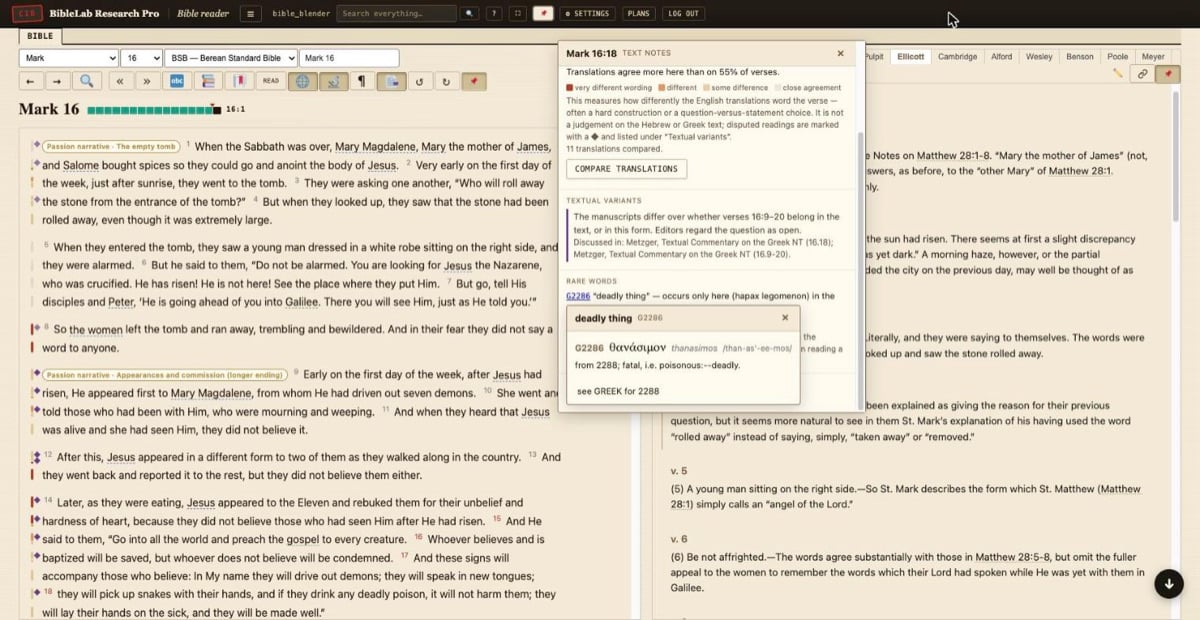
Turn on Text notes and every verse shows how closely the English translations agree on it, and whether the ancient manuscripts differ there. It tells you which verses to read slowly before you build a sermon or a study on a single word.
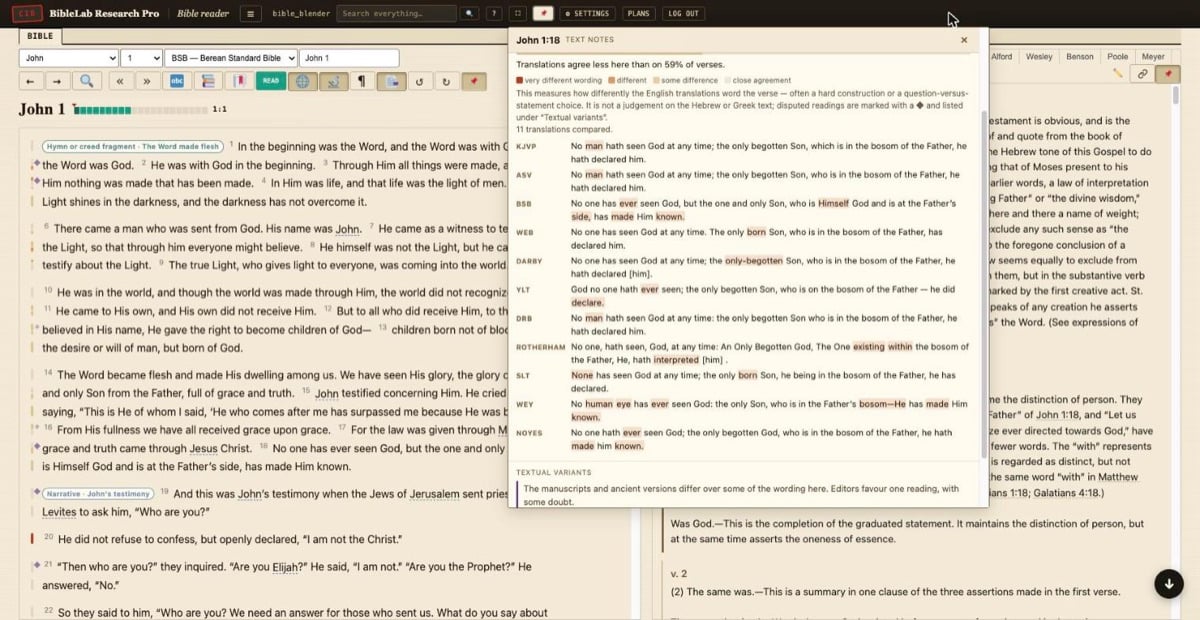
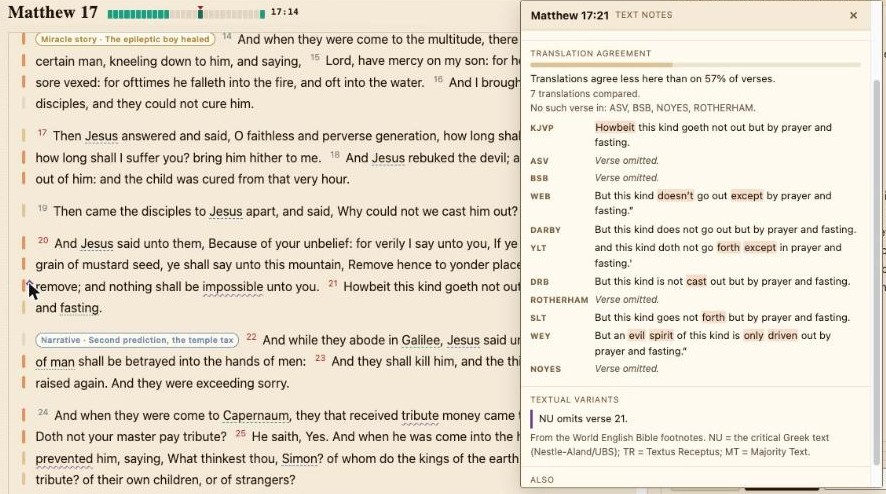
- Translation agreement. A bar beside every line, measured across 12 translations. A strong colour means they word the verse very differently — usually a sign of hard Hebrew or Greek.
- Compare translations. One click lays the verse out in every translation, with the words that differ marked.
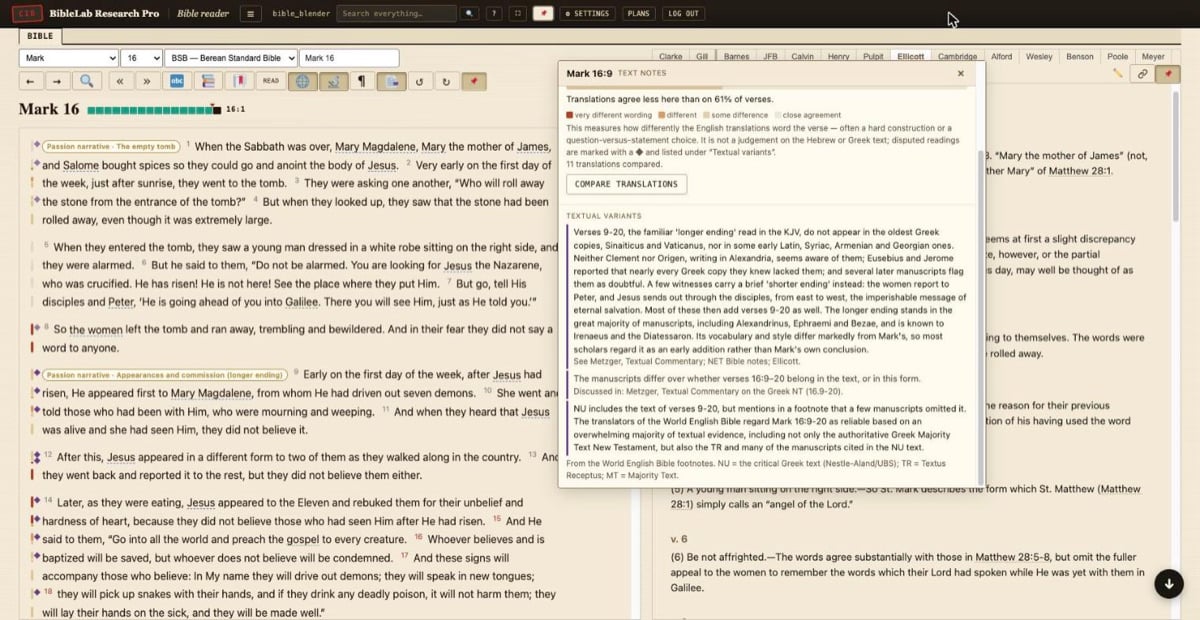
- Manuscript differences. A diamond marks every verse where the manuscripts or ancient versions differ — about 7,000 verses across the whole Bible. Its strength shows how much is at stake: a few words, a whole verse, or a passage like the end of Mark.
- How sure scholars are. For each difference: whether the evidence is clear, leans one way, or is open, and how the other readings most likely arose (a copyist’s slip, smoothing a hard text, a modern guess).
- Written notes. Plain-English notes on the variants themselves — what the manuscripts read and which reading your translation follows — already in Genesis, Isaiah, Matthew and Mark, with more books being added.
- Rare words, passage forms and words of Jesus. Words that occur only a few times in Scripture are linked to the lexicon; every passage is labelled by kind (narrative, law, lament, parable and 50 more).
Commentaries 7 of 46 free · more on paid plans
46 commentaries, kept on the verse you are reading
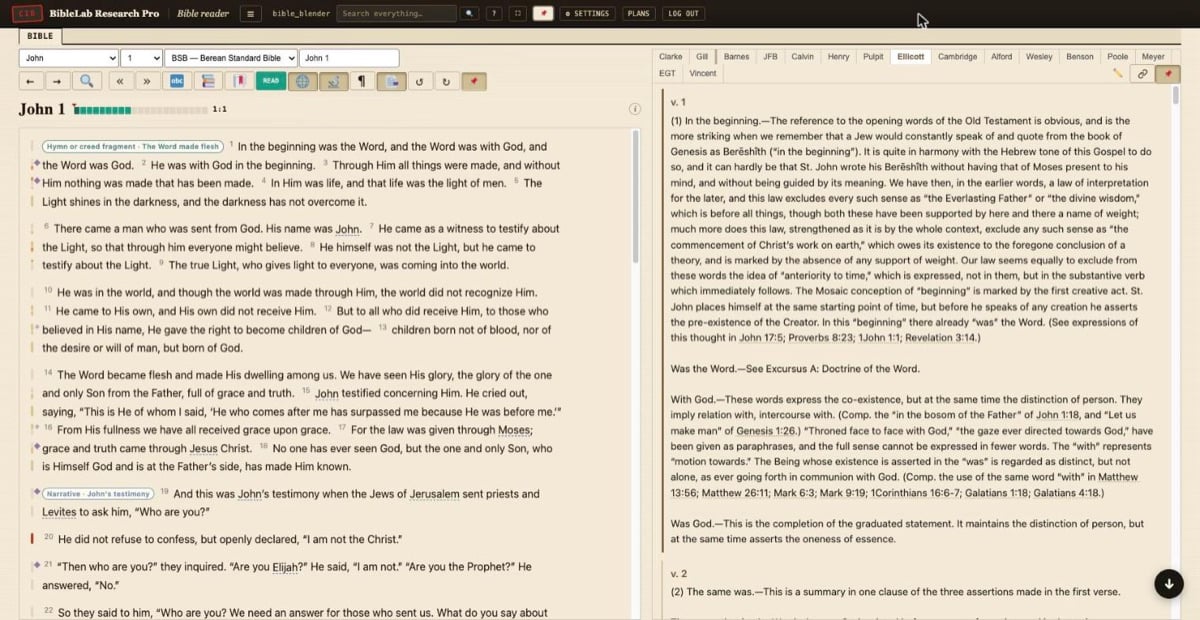
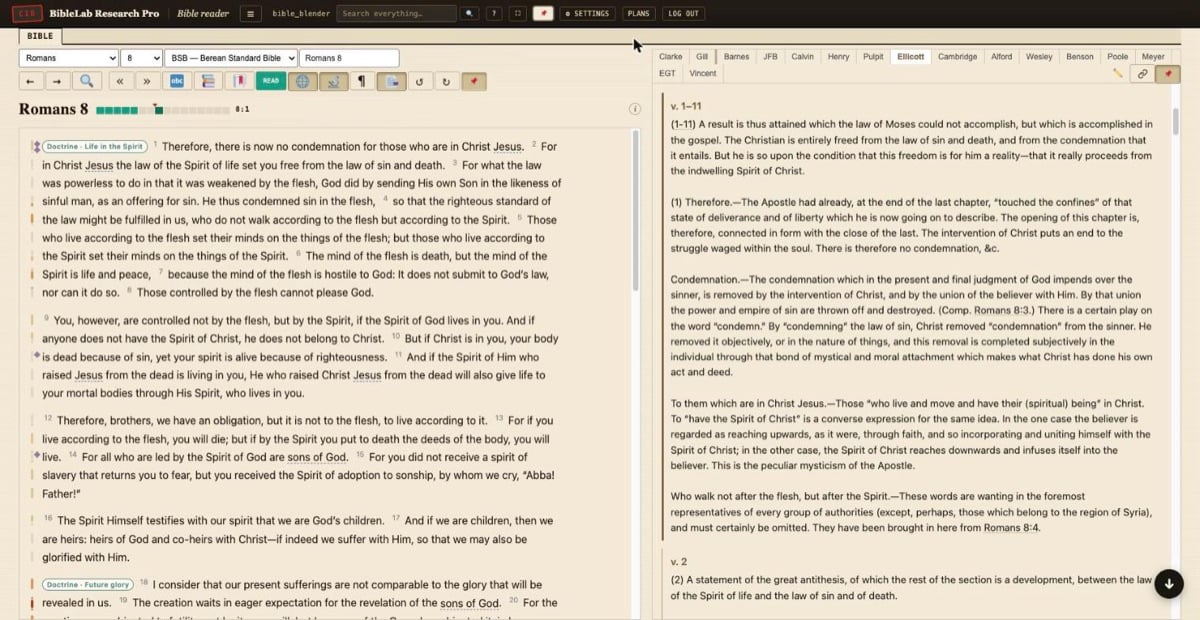
Open any commentary beside the text and it follows you verse by verse. Matthew Henry, Jamieson-Fausset-Brown, Barnes, Clarke, Gill, Keil & Delitzsch, Ellicott, the Pulpit Commentary, the Cambridge Bible, Alford’s Greek Testament, Calvin, and many more.
- Pin a commentary to keep it in place while you read on, or tab between several.
- Highlight in the commentaries just as you do in the Bible text.
- Select a word in a commentary to define it: the Bible dictionaries first, then Webster’s.
- Scripture references inside a commentary open where you are; citations of Josephus, the Fathers and other ancient writers open the source itself.
Hebrew & Greek Paid plans
The original languages, a click away
See the Hebrew or Greek behind the English in 5 lexicons — Brown-Driver-Briggs, Abbott-Smith, Middle Liddell, Dodson and Strong’s.
- Read the King James Version with Strong’s numbers: every tagged word opens its Hebrew or Greek entry with a click (paid plans).
- Rare words marked by Text notes open their lexicon entry from the verse.
- Strong’s and Goodrick-Kohlenberger numbers in commentaries and study notes ("GK 1347") open the same popup.
Concordance Free
Every occurrence of a word
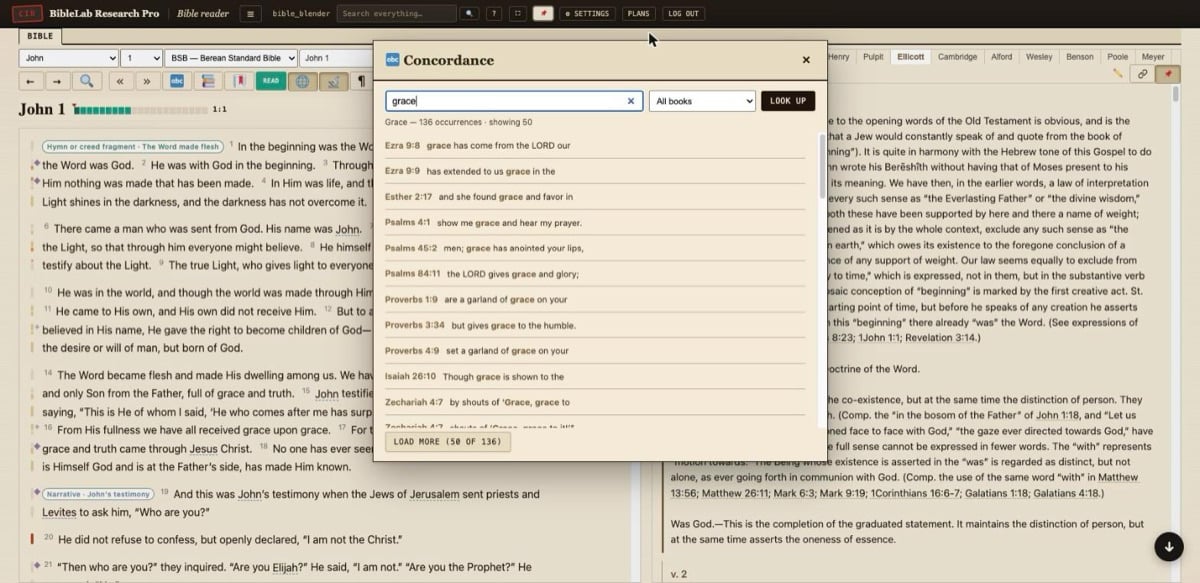
Double-click any word, or open the concordance, to list every verse in which it occurs, with the verse text around it.
- Jump straight to any occurrence in the reader.
Reference shelf 3 of 7 free · more on paid plans
7 Bible dictionaries and reference works
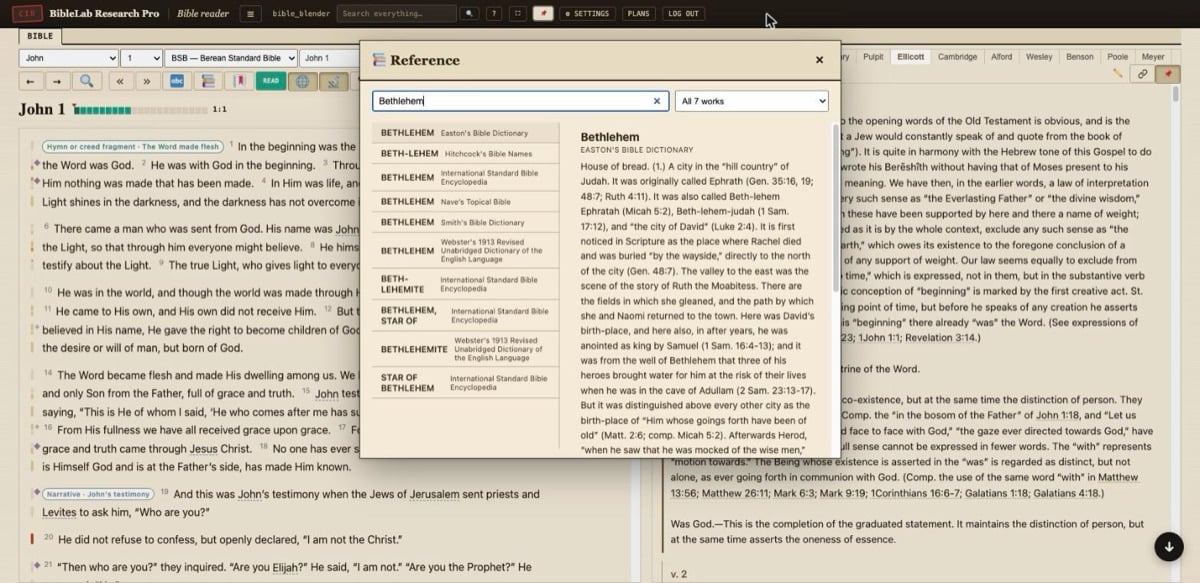
The International Standard Bible Encyclopedia, Easton’s and Smith’s Bible Dictionaries, Nave’s Topical Bible, Torrey’s Topical Textbook and Hitchcock’s Bible Names — searchable from anywhere in the app.
- Look up a person, place or idea without leaving the verse.
- Every reference in an article opens in the reader.
Ancient sources Many free · more on paid plans
The texts the commentators quote
When a commentary cites Josephus, a Church Father, a rabbinic source or a Roman historian, the citation is a link: it opens the passage itself.
- Josephus and Philo; the Ante-Nicene and Nicene Fathers (hundreds of works, from Clement to Augustine and Chrysostom).
- The Book of Enoch, Jubilees, 2 Baruch and other pseudepigrapha; the Targums, Mishnah, Tosefta, Midrash and the medieval Jewish commentators.
- Herodotus, Tacitus, Suetonius, Pliny, Plutarch, Strabo, Juvenal and other classical writers.
- Ancient Near Eastern parallels: cuneiform texts, Egyptian records and Assyrian annals.
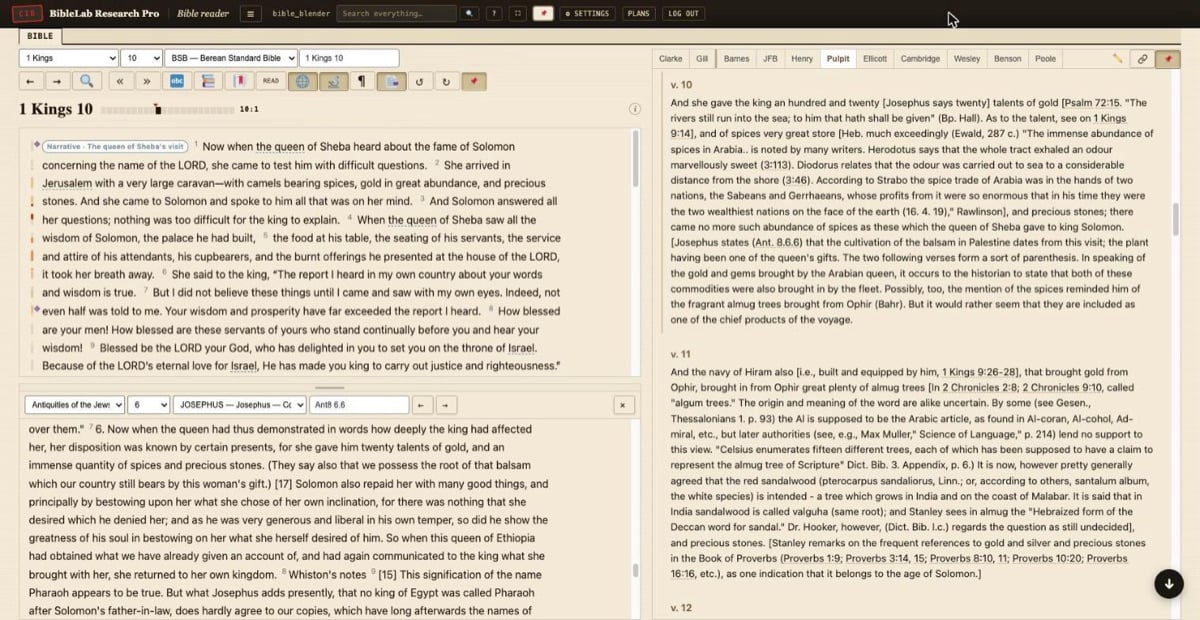
Library search Free
Search the whole library
Find a commentary, an author, a work of the Fathers or an article in the reference shelf by name or topic, and open it where it applies.
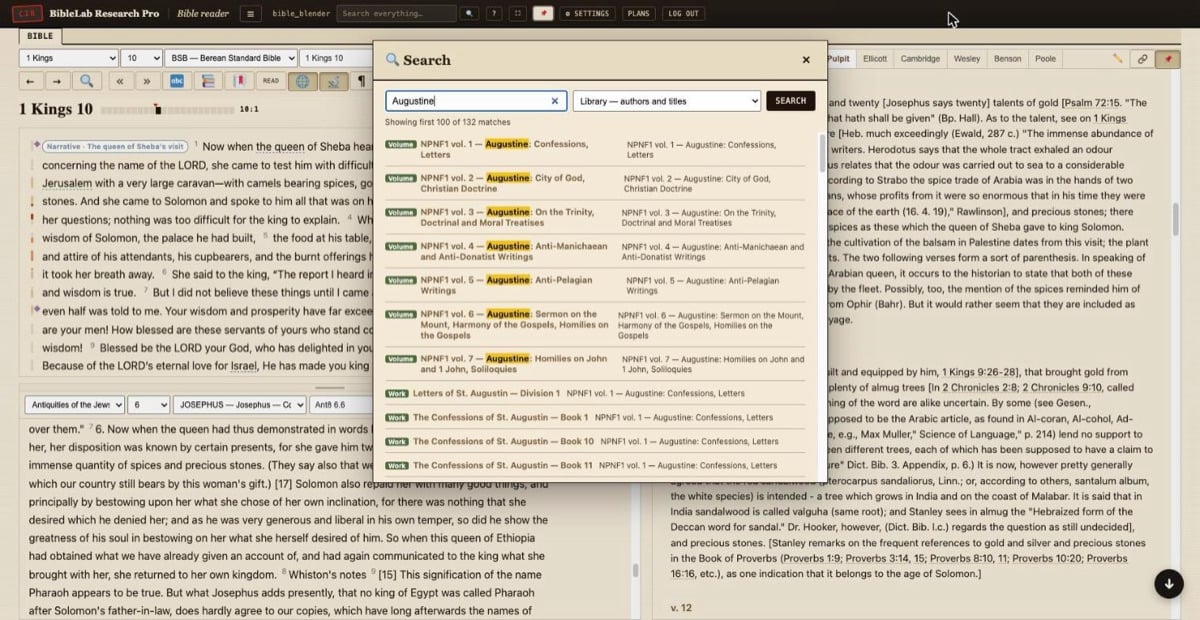
Your studies Free account: 1 study
Notes, highlights and everything you find, tied to the verse
A study is a workspace for one book, person, question or sermon series. Everything in it hangs off the verses it concerns, so it is there again the next time you read the passage.
- Notes on any verse or range, with colour highlights in the Bible and the commentaries.
- Track characters, places, artifacts and groups across every book: each has its own description and history, is marked in the text where it appears, and carries across your studies.
- Events, questions and attached documents and images (with text recognition for scanned pages).
- Find any note again from the verse, the person or the place.
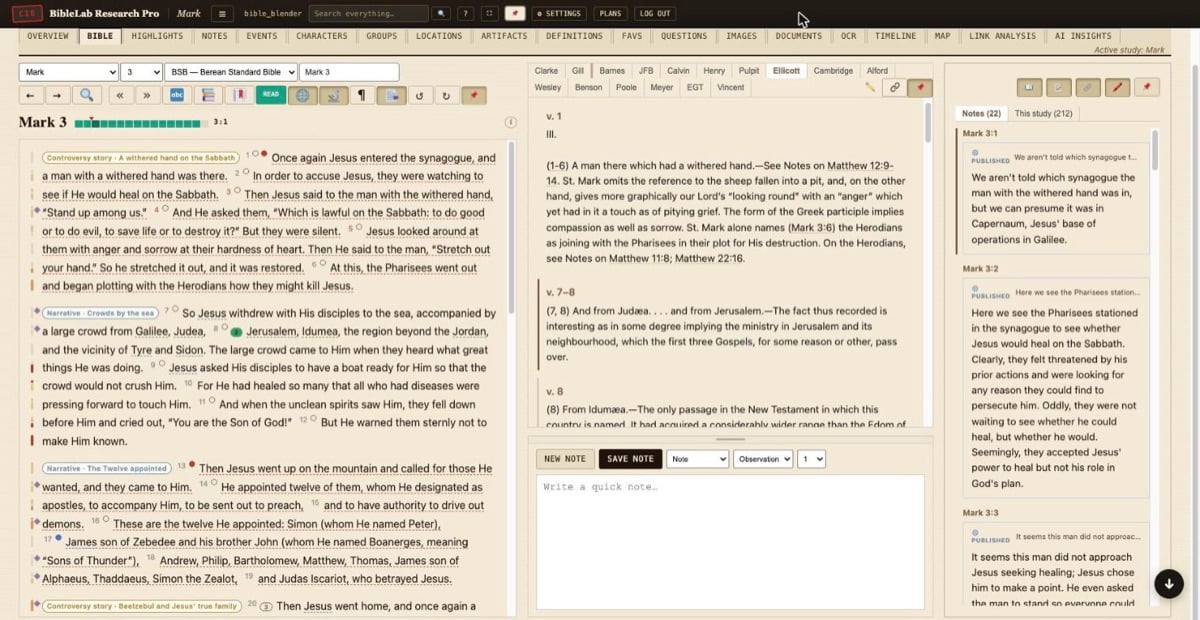
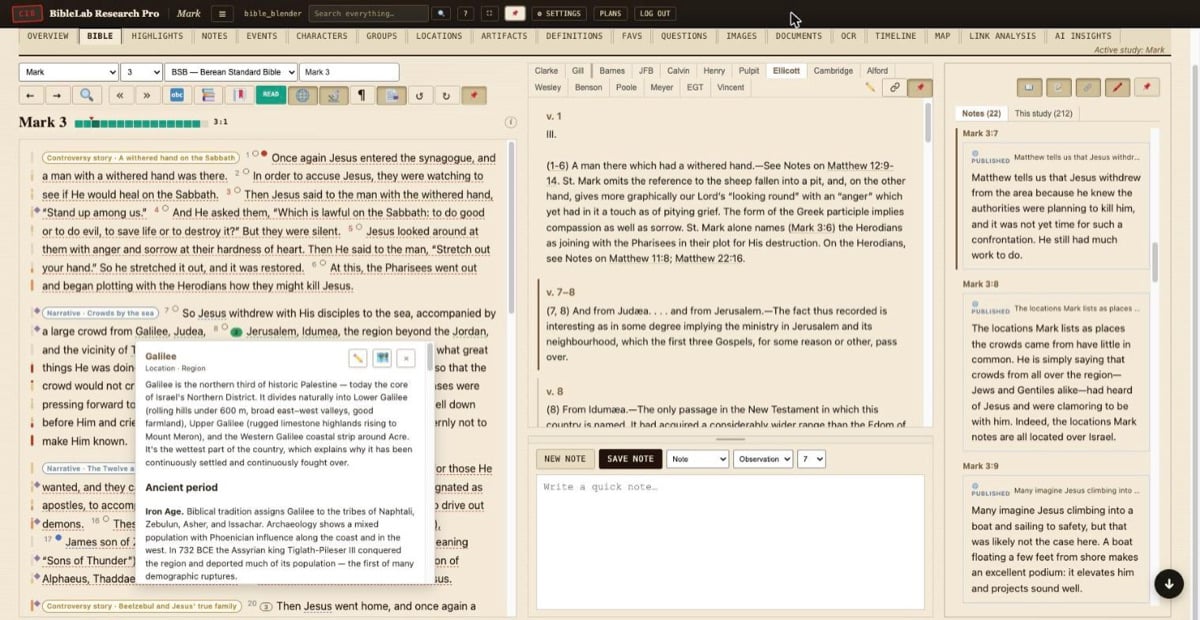
Maps & timelines Free account
See where it happened, and when
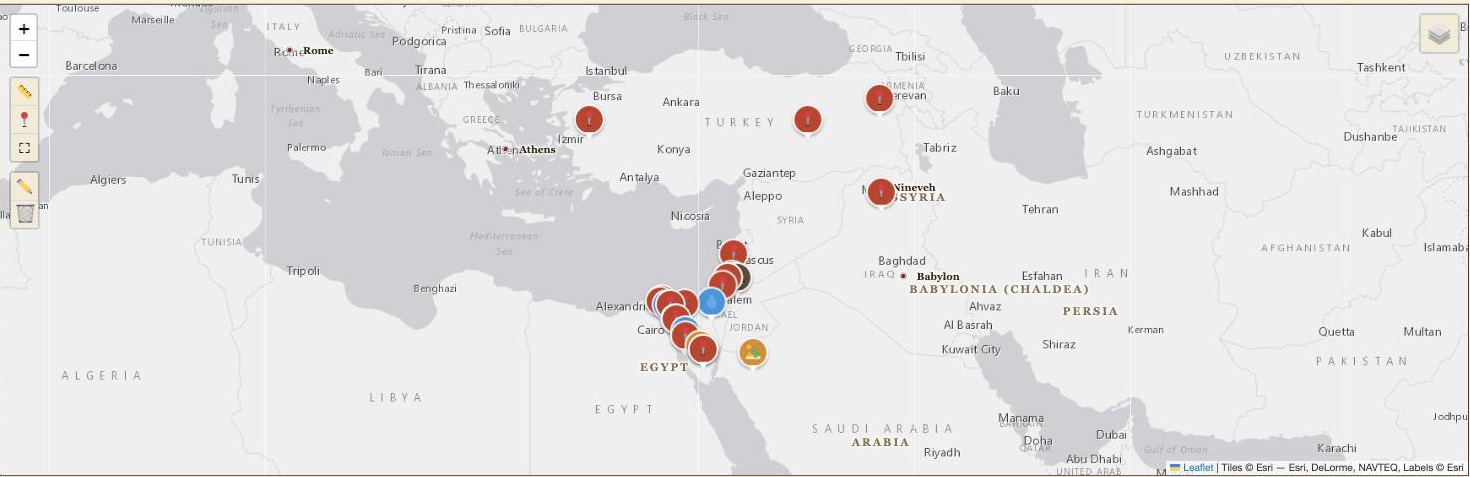
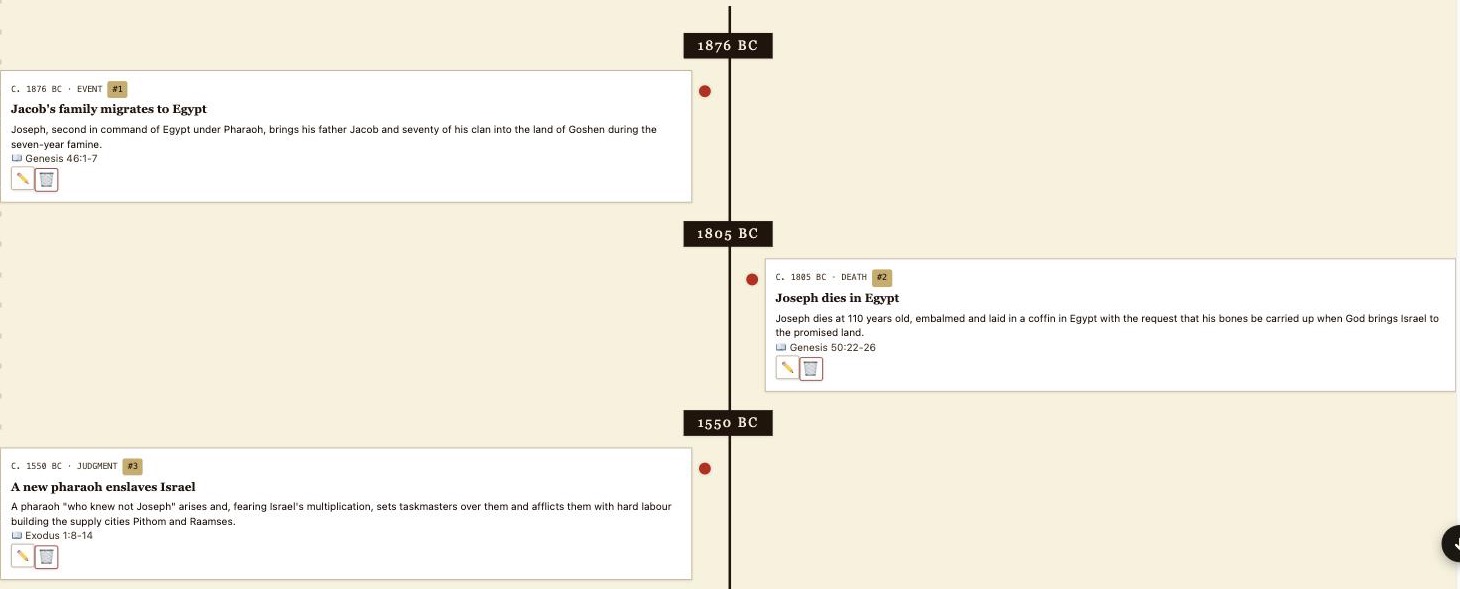
Plot your study’s places on a map and draw the journeys between them. Lay its events out on a timeline in order.
Link analysis Paid plans
How it all connects
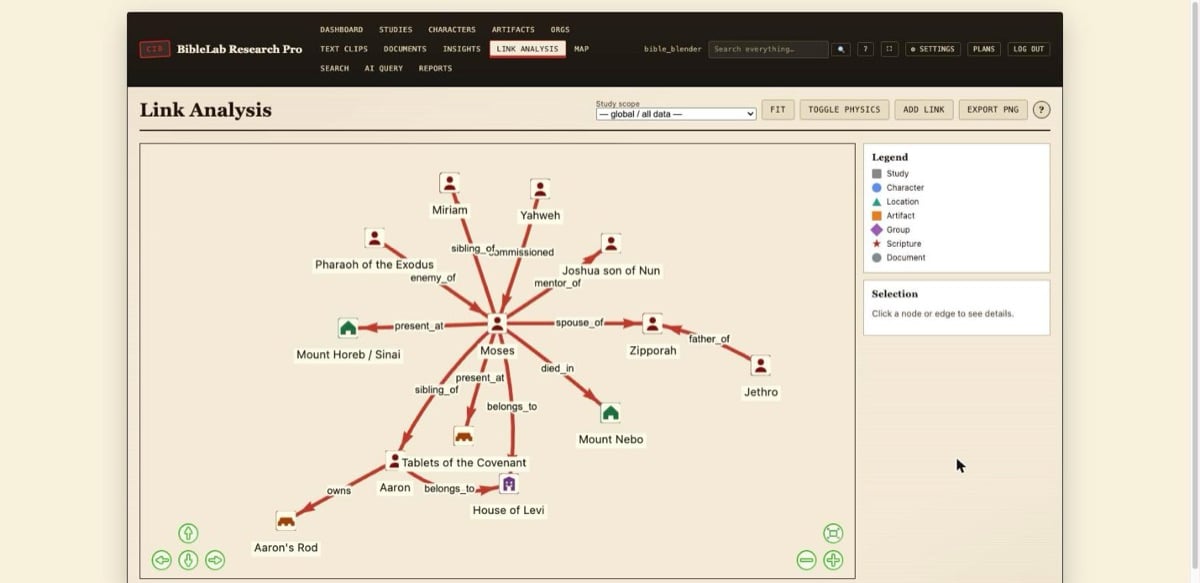
A relationship graph of your study: people, places, events and passages, and the links between them.
Reading progress Free account
Keep track of your reading
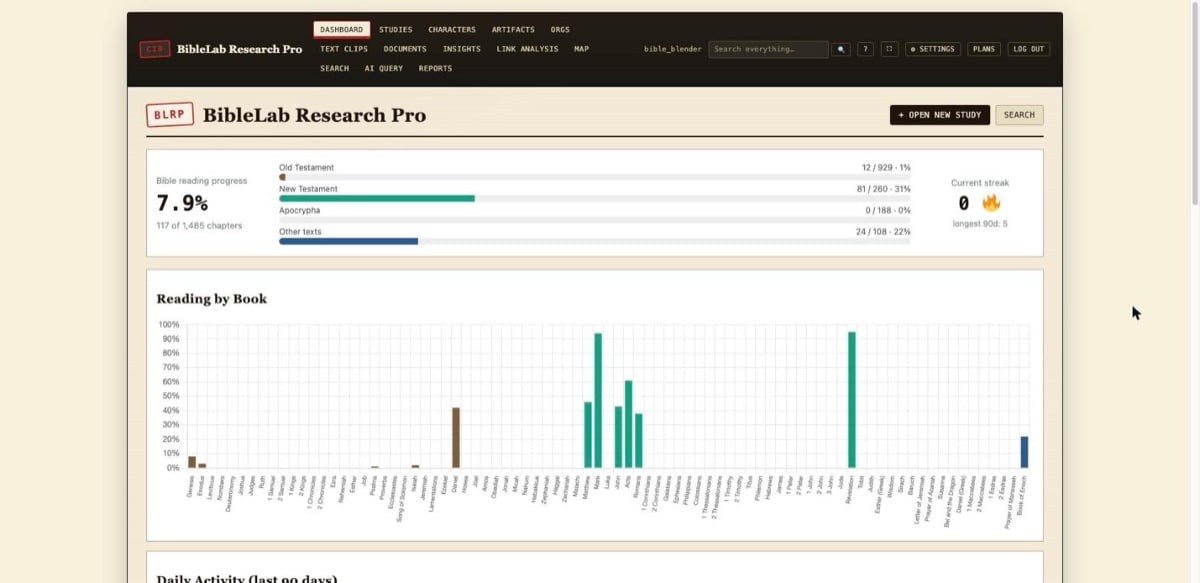
The dashboard shows how much of each book and testament you have read, your daily activity and your reading streak.
Start free
- The reader, the public-domain Bibles and the classic commentaries — no account needed.
- A free account adds a study of your own, with notes, highlights, people, places, map and timeline.
Go further
- Paid plans add Text notes (translation agreement and manuscript notes), more studies, sharing, modern translations, the KJV with Strong’s numbers, scholarly commentaries, the lexicons and the concordance.