

Outline/Summary
The first miracle
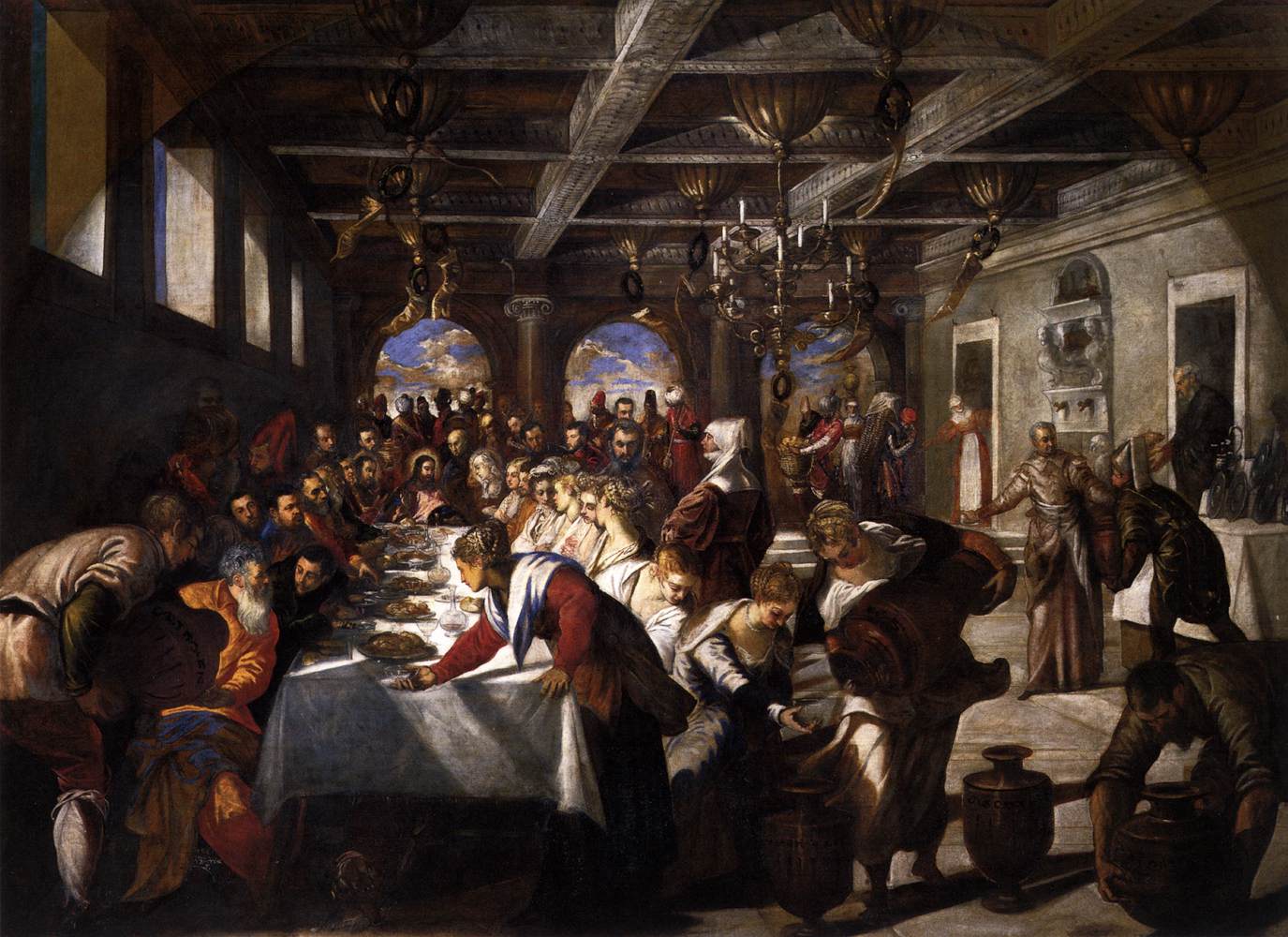
On the third day, there was a wedding in Cana in Galilee. Jesus’ mother was there and Jesus and his disciples had also been invited to the wedding. When the wine was gone, Jesus’ mother said to him, “They have no more wine.”
“Woman, why do you involve me? Jesus replied. “My hour has not yet come.”
His mother said to the servants, “Do whatever he tells you.”
Nearby stood six stone water jars, the kind the Jews used for ceremonial washing, each holding from 20 to 30 gallons. Jesus told the servants, “Fill the jars with water.”
So the servants filled them to the brim.
Then Jesus told them, “Now draw some out and take it to the master of the banquet.”
They did so, and the master of the banquet tasted the water that had been turned into wine. He did not realize where it had come from, though the servants who drew the water knew.
Then he called the bridegroom aside and said, “Everyone brings out the expensive wine first and then the cheaper wine after the guests have had too much to drink. But you have saved the best until now.”
What Jesus did there in Cana of Galilee was the first of the signs through which he revealed his glory – and his disciples believed in him.
After this, they went down to Capernaum with his mother and his disciples. There they stayed for a few days.
What the story means to us today
The disciples are given proof that Jesus is the Messiah
It is remarkable to see that Jesus was encouraged to perform his first miracle by his mother. Whether Mary wanted Jesus to resolve the situation is unclear from the texts. But Mary almost certainly knew her son was not normal (after all, he was conceived from a virgin birth). And it was clear he was gathering his disciples for a world-changing mission. She was almost certainly aware of Jesus’ plan. So it is possible that this was Mary’s way of telling Jesus, “It is time.”
Indeed, up to this point, the disciples had chosen to follow Jesus on faith alone. Now they witness the first manifestation of God’s power in Jesus himself. And the verses tell us “his disciples believed in him”.
Deeper insights and further considerations
“My hour has not yet come”
When Mary informs Jesus that the wine has run out, he responds with, “Woman, why do you involve me? My hour has not yet come?”
Modern ears interpret this differently than ancient readers would have. There is no antagonism in Jesus’ reply. He is simply saying, “Why turn to me? My time has not yet come?”
But Mary seems to know that Jesus’ time is now. Thus, she instructs the servants to follow Jesus’ lead.
Jesus’ mother launches his ministry
Notably, Mary’s request prompted the first miracle recorded in John. Mary would have known that Jesus was special. After all, she alone knew he was truly conceived by a virgin birth.
She may have seen other signs that he was gifted with supernatural abilities (though any prior miracles are not recorded in our accepted New Testament canon). And certainly Jesus’ response, “My time has not yet come,” would have been understood that his messianic purpose was to present itself at some future point in time.
Drunkenness in the Bible
The Bible never condones alcohol or getting drunk on alcohol. But in Jesus’ day, wine was a typical drink for all. The area had readily available resources (grapes), wine was easy to make, and it was easy to store. But it was also quite different from the wine we have today.
In Jesus’ day, it was common to dilute wines with 3 parts water to 1 part wine, making a drink that was mostly water with a bit of wine/grape flavor. Of course, if one chose not to dilute the wine, it could bring about drunkenness if enough were consumed.
A tricky sleight of hand?
Inevitably, the mind begins to conjure up alternatives to make an impossible event fit into something we can comprehend. But Jesus’ act was no trick. This was a banquet attended by likely hundreds of people who witnessed the event firsthand. The wine jars were very heavy (about 200 pounds each), required a massive amount of liquid to fill them (more than 150 gallons, according to scripture), and could not be easily moved about. Finally, the miracle was so profound that it led the disciples to believe Jesus was truly the Messiah.
These and other miracles of Jesus served to convince people and the disciples that he was the Son of God, which explains the extraordinary rise in his popularity in the region. Of course, years later, he would perform the ultimate miracle—rising from the dead—that would cement his place in history and give rise to the religion we celebrate today.
The scientific and historical fundamentals that support the story
Cana of Galilee
There were several “Canas” in Jesus’ day. It was thought to be the site of Kefr Kenna, some four miles outside Nazareth on the road leading toward Tiberias. Or it may have been the unexcavated village of Khirbet Oana, located about 8 miles northeast of Nazareth. The ancient historian Josephus mentions staying in the city.
Ancient weddings
Weddings in Jesus’ time took place at the bridegroom’s home and were followed by a procession in which the bridegroom’s friends brought the bride to his house. The celebration could last several days and included daily feasts celebrating the couple’s union. Thus, John’s mention of the “third day” could refer to the third day of the wedding.
20-gallon stone water jars
The jars were specifically noted as being made of stone, not earthenware. Jars unearthed in Palestine show they were carved from single blocks of stone. This means the stone would be unable to absorb contaminants or old remnants of previous wine. The construction method would have been important to ancient Jews to prevent contamination.
The original text states they held 2 or 3 metretes. A metretes was roughly 9 gallons, so 2 or 3 metretes would contain between 18 and 27 gallons. Therefore, the total volume of all the jars was between 108 to 162 gallons of wine! Anyone trying to claim Jesus’ miracle was a deception would need to explain how some could secretly smuggle more than a hundred gallons of wine weighing more than 1,000 pounds into a crowded wedding event.
Notes on Biblical translation
“Woman”
Today, addressing a female as “woman” is considered an affront, but in Jesus’ time, it was the normal way to address a woman. Remember that even on the cross, in his final moments, Jesus says to Mary, “Woman, here is your son.”
Bible text
NIV
2 On the third day, a wedding took place at Cana in Galilee. Jesus’ mother was there, 2 and Jesus and his disciples had also been invited to the wedding. 3 When the wine was gone, Jesus’ mother said to him, “They have no more wine.”
4 “Woman, why do you involve me?” Jesus replied. “My hour has not yet come.”
5 His mother said to the servants, “Do whatever he tells you.”
6 Nearby stood six stone water jars, the kind used by the Jews for ceremonial washing, each holding from twenty to thirty gallons.
7 Jesus said to the servants, “Fill the jars with water”; so they filled them to the brim.
8 Then he told them, “Now draw some out and take it to the master of the banquet.”
They did so, 9 and the master of the banquet tasted the water that had been turned into wine. He did not realize where it had come from, though the servants who had drawn the water knew. Then he called the bridegroom aside 10 and said, “Everyone brings out the choice wine first and then the cheaper wine after the guests have had too much to drink; but you have saved the best till now.”
11 What Jesus did here in Cana of Galilee was the first of the signs through which he revealed his glory; and his disciples believed in him.
12 After this he went down to Capernaum with his mother and brothers and his disciples. There they stayed for a few days.
NET Bible
2:1 Now on the third day there was a wedding at Cana in Galilee. Jesus’ mother was there, 2:2 and Jesus and his disciples were also invited to the wedding. 2:3 When the wine ran out, Jesus’ mother said to him, “They have no wine left.” 2:4 Jesus replied, “Woman, why are you saying this to me? My time has not yet come.” 2:5 His mother told the servants, “Whatever he tells you, do it.”
2:6 Now there were six stone water jars there for Jewish ceremonial washing, each holding twenty or thirty gallons. 2:7 Jesus told the servants, “Fill the water jars with water.” So they filled them up to the very top. 2:8 Then he told them, “Now draw some out and take it to the head steward,” and they did. 2:9 When the head steward tasted the water that had been turned to wine, not knowing where it came from (though the servants who had drawn the water knew), he called the bridegroom 2:10 and said to him, “Everyone serves the good wine first, and then the cheaper wine when the guests are drunk. You have kept the good wine until now!” 2:11 Jesus did this as the first of his miraculous signs, in Cana of Galilee. In this way he revealed his glory, and his disciples believed in him.
2:12 After this he went down to Capernaum with his mother and brothers and his disciples, and they stayed there a few days.
NKJV
2 On the third day there was a wedding in Cana of Galilee, and the mother of Jesus was there. 2 Now both Jesus and His disciples were invited to the wedding. 3 And when they ran out of wine, the mother of Jesus said to Him, “They have no wine.”
4 Jesus said to her, “Woman, what does your concern have to do with Me? My hour has not yet come.”
5 His mother said to the servants, “Whatever He says to you, do it.”
6 Now there were set there six waterpots of stone, according to the manner of purification of the Jews, containing twenty or thirty gallons apiece. 7 Jesus said to them, “Fill the waterpots with water.” And they filled them up to the brim. 8 And He said to them, “Draw some out now, and take it to the master of the feast.” And they took it. 9 When the master of the feast had tasted the water that was made wine, and did not know where it came from (but the servants who had drawn the water knew), the master of the feast called the bridegroom. 10 And he said to him, “Every man at the beginning sets out the good wine, and when the guests have well drunk, then the inferior. You have kept the good wine until now!”
11 This beginning of signs Jesus did in Cana of Galilee, and manifested His glory; and His disciples believed in Him.
12 After this He went down to Capernaum, He, His mother, His brothers, and His disciples; and they did not stay there many days.
The Message
1–3 2 Three days later, there was a wedding in the village of Cana in Galilee. Jesus’ mother was there. Jesus and his disciples were guests also. When they started running low on wine at the wedding banquet, Jesus’ mother told him, “They’re just about out of wine.”
4 Jesus said, “Is that any of our business, Mother—yours or mine? This isn’t my time. Don’t push me.”
5 She went ahead anyway, telling the servants, “Whatever he tells you, do it.”
6–7 Six stoneware water pots were there, used by the Jews for ritual washings. Each held twenty to thirty gallons. Jesus ordered the servants, “Fill the pots with water.” And they filled them to the brim.
8 “Now fill your pitchers and take them to the host,” Jesus said, and they did.
9–10 When the host tasted the water that had become wine (he didn’t know what had just happened but the servants, of course, knew), he called out to the bridegroom, “Everybody I know begins with their finest wines and after the guests have had their fill brings in the cheap stuff. But you’ve saved the best till now!”
11 This act in Cana of Galilee was the first sign Jesus gave, the first glimpse of his glory. And his disciples believed in him.
12 After this he went down to Capernaum along with his mother, brothers, and disciples, and stayed several days.
KJV
2 And the third day there was a marriage in Cana of Galilee; and the mother of Jesus was there: 2 And both Jesus was called, and his disciples, to the marriage. 3 And when they wanted wine, the mother of Jesus saith unto him, They have no wine. 4 Jesus saith unto her, Woman, what have I to do with thee? mine hour is not yet come. 5 His mother saith unto the servants, Whatsoever he saith unto you, do it. 6 And there were set there six waterpots of stone, after the manner of the purifying of the Jews, containing two or three firkins apiece. 7 Jesus saith unto them, Fill the waterpots with water. And they filled them up to the brim. 8 And he saith unto them, Draw out now, and bear unto the governor of the feast. And they bare it. 9 When the ruler of the feast had tasted the water that was made wine, and knew not whence it was: (but the servants which drew the water knew;) the governor of the feast called the bridegroom, 10 And saith unto him, Every man at the beginning doth set forth good wine; and when men have well drunk, then that which is worse: but thou hast kept the good wine until now. 11 This beginning of miracles did Jesus in Cana of Galilee, and manifested forth his glory; and his disciples believed on him.
12 After this he went down to Capernaum, he, and his mother, and his brethren, and his disciples: and they continued there not many days.
Image Credits:
• Marriage at Cana via Wikimedia Commons by Jacopo Tintoretto with usage type - Public Domain, 1519-1594
Featured Image Credit:
• Marriage at Cana via Wikimedia Commons by Jacopo Tintoretto with usage type - Public Domain, 1519-1594