

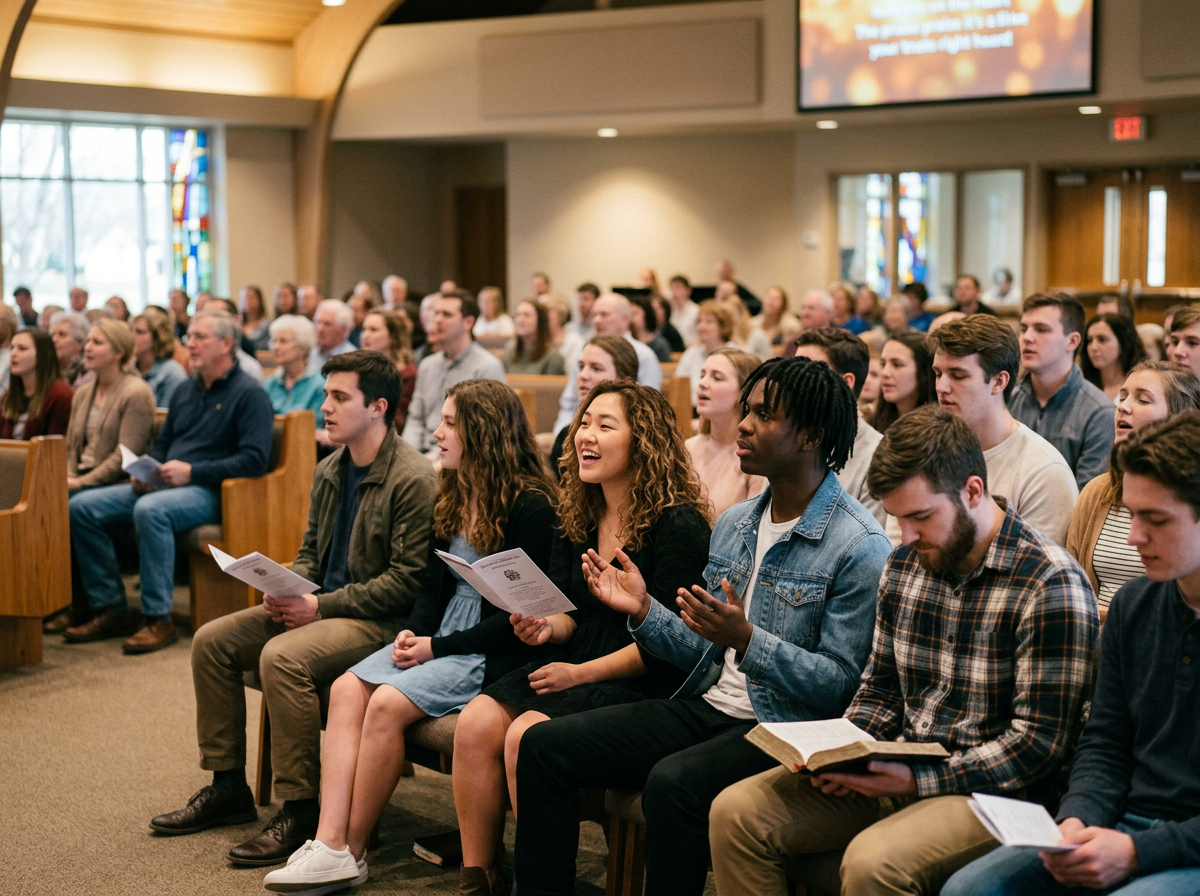
A new Harris Poll suggests Generation Z adults are now the U.S. age group most likely to describe themselves as religious, bucking years of data showing younger Americans drifting from organized faith.
In the nationally focused survey, 33% of Gen Z respondents said they consider themselves “religious,” compared with 18% of baby boomers, 22% of Generation X and 19% of millennials, making Gen Z the most religious-identifying generation in the poll.
The same Harris Poll found that Gen Z adults were also the least likely to say they are neither religious nor spiritual, with 19% choosing that description versus roughly one-fifth or more in older cohorts, underscoring that most young adults see themselves as engaged with some form of belief or practice.
Survey questions invited Americans to place themselves on a spectrum from religious to spiritual to neither, and follow-up reporting by outlets such as Fortune, USA Today and IBTimes noted that nearly nine in 10 Gen Z respondents reported regularly engaging in at least one spiritual or religious activity in the past year.
Those practices range from familiar Christian disciplines like prayer, Scripture reading and attending religious services to activities often considered outside historic Christian teaching, including meditation or ritual, manifestation, astrology or tarot, and energy work, highlighting how Gen Z is combining institutional religion with eclectic spirituality.
The Harris findings arrive amid a broader research landscape that has generally painted Gen Z as the least institutionally religious American generation, with studies from PRRI and the American Survey Center reporting that roughly one-third of Gen Z identify as religiously unaffiliated and fewer as white Christians than older cohorts.
Gallup data synthesized from 2020 to 2024 likewise indicates that younger adults are more likely to say they have no religious preference, and reporting on that research notes that about a third of Gen Z and millennials describe themselves as not religious at all, suggesting a tension between long-term affiliation trends and the new Harris snapshot of religious self-understanding.
Christian researchers have been tracking that tension for several years, with Barna Group’s Gen Z project finding that teens are less likely than older generations to identify as Christian even as many express interest in spirituality and meaning, a pattern that helps explain why a generation long expected to abandon belief entirely is instead mixing revived religious language with alternative spiritual practices.
Commentary in mainstream outlets covering the Harris Poll emphasizes that this blend of church-based and non-traditional practices may complicate how pastors, campus ministries and denominational leaders interpret “religious” labels, and it is likely to spur further polling and qualitative research as Christian organizations and social scientists watch how Gen Z’s evolving spiritual identity shapes congregational life and public faith conversations in the coming years.